
Newtown Previous Residents Sources
The record trail for Newtown previous residents is layered. Town land books establish recorded transfers, directories place names at an address, newspapers explain life events, and local files bridge the years between those sources. The coverage table keeps ownership, occupancy, map history, and household evidence in separate lanes so a gap in one source does not get mistaken for a gap in the whole trail.
| Source | Local years covered | Where held | What it contributes |
|---|---|---|---|
| Town land records | 1711-present in Town holdings | Newtown Town Clerk | Deeds, mortgages, maps, and recorded legal instruments |
| SearchIQS land index and images | Index-only 1900-1911; mixed 1911-1916; index/images 1916-present; Town image page says July 1966-current | SearchIQS and Town Clerk | Online chain with an early-image range that needs Clerk confirmation |
| Grantor/grantee index books | 1700-1948 | SearchIQS and Town Clerk | Name bridge into older deed books |
| Map indexes and images | 1904-1959 index-only; December 14, 1959-present index/images | SearchIQS and Town Clerk | Map number, subdivision, and legal-description bridge |
| Bridgeport Public Library directories | 1963, 1965, 1967, 1969, 1971-72, 1974, 1976, 1978, 1981 | History Center | Historical occupant, address, and telephone snapshots |
| LOC regional telephone sample | 1956-1959 | Library of Congress | Newtown entries in a Danbury-area regional book |
| Newtown Bee | 1877-current catalog; selected film runs | LOC, film holdings, and Booth | Notices, obituaries, civic names, and move clues |
| 1890 substitute records | 1890 | Booth and Genealogy Club files | School, Grand List, voter, and new-elector household reconstruction |
| Federal census | 1790-1950, subject to the 72-year release rule | NARA, FamilySearch, and libraries | Household context, not exact modern situs continuity |
| Building and land-use files | No online start year located | Town counters or FOI request | Construction, alteration, inspection, and applicant clues when releasable |
| Sanborn fire-insurance maps | Newtown-specific year not located | LOC guide and archives | Structures, uses, lots, and fire-water details if a sheet is found |
Start with the source that matches the question. A title question begins with a deed and legal description. A household question begins with a directory or census. A death or heir question may end at an obituary or probate file. Newtown's Town Clerk, not a Fairfield County recorder, is the local land-record counter because Connecticut has no operating county records government.
Newtown's Previous-Resident Cutoffs
SearchIQS has two coverage statements that should remain visible. Its Newtown help page gives index-only land material for 1900-1911, mixed index and some images for 1911-1916, and index plus images from 1916 forward. The Town's public records page describes land-record images as July 1966-current. That is a real access conflict, not a reason to choose the newer-looking date. Ask the Town Clerk about the exact book, image, or index volume before promising a scan.
| Party 1 and Party 2 | Last-name-first name fields for grantor, grantee, or another recorded party. |
|---|---|
| Date From and Thru | Recording-date range that narrows a deed or map search. |
| Document group and description | Record-type filters that help separate deeds, mortgages, maps, and related instruments. |
| Town, book, page, instrument | Placement fields; a map number may be entered in Instrument when the help page directs it. |
| Image indicator | An asterisk identifies an image-bearing result, but restricted or non-digitized material may still need the counter. |
The grantor/grantee index books reach 1700-1948 and are the bridge when a modern street search stops. The index can name the parties and point to a book or page even when the image is not online. SearchIQS also documents map indexes from 1904, with map index and image coverage changing on December 14, 1959. Preserve the result fields and then move to the Town Clerk books when the image flag or date range becomes uncertain.
The SearchIQS Newtown help page is the source for these range notes and the grantor/grantee bridge.
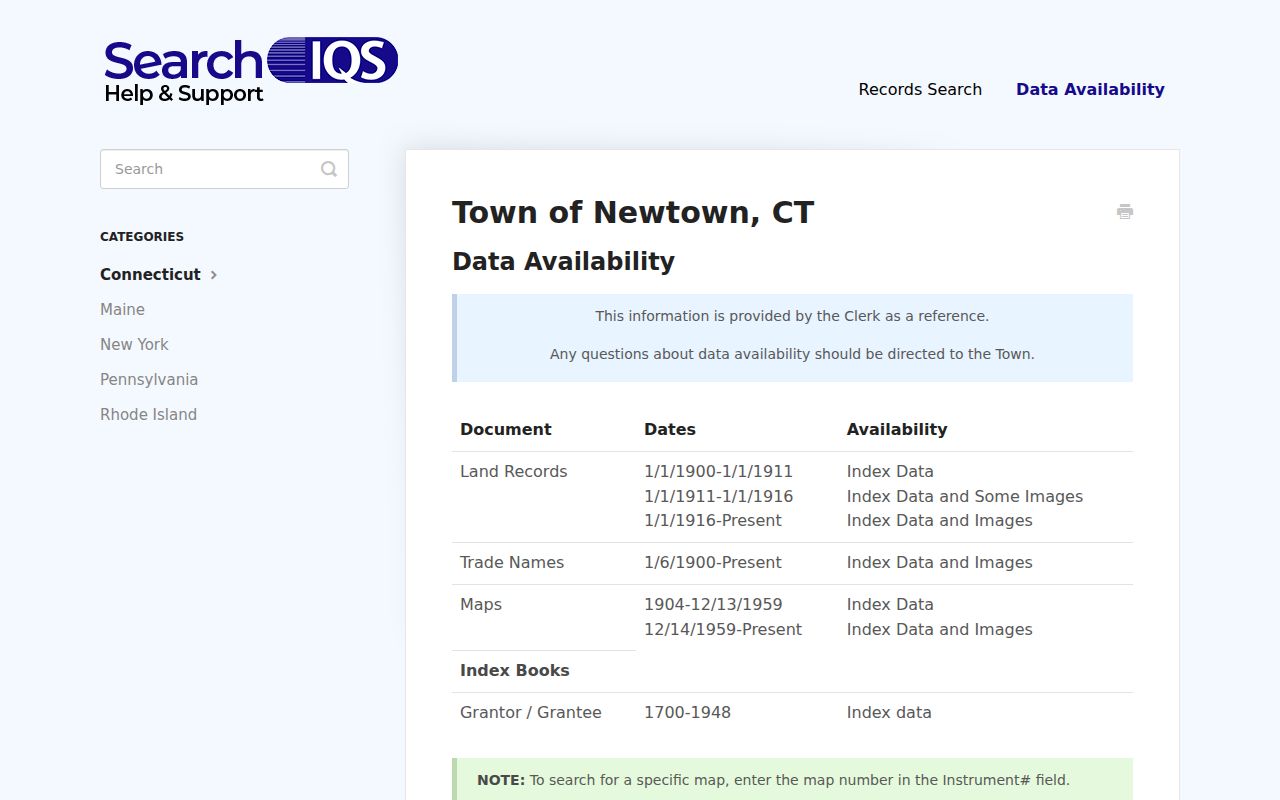
The help image is a coverage guide, not a deed result. Use it to choose the next search path, then confirm a particular record with the Town Clerk.
Newtown Parcels and Residents
A current address needs a stable land key before it can lead to earlier occupants. Newtown MapXpress searches by house number and street, owner name, or MBL. Its page says last name works best for the name search, and the MBL field accepts a map-block-lot form such as 26-3-27. The parcel card then supplies a unique ID, account, situs, owner name, MBL, acreage, land use, zoning, coordinates, and links to a quick map or property card.
Use the Newtown GIS MapXpress search to locate the parcel, then compare the result with the Newtown Vision assessment card. Save the situs address and the mailing address separately. A parcel can have a Newtown situs and a Bethel mailing address, so the mailing line is a clue about the tax record, not proof of where a person lived.
Current address → MBL and legal description → latest deed → grantor/grantee search → earlier deed or map book.
Newtown Deeds for Past Residents
Deed backtracking starts with the current parcel, not with a guessed surname. The assessor or GIS card supplies a present owner lead, MBL, situs, and sale reference. The recorded instrument controls the title trail. Search the buyer as grantee, identify the seller as grantor, and use that seller as the next grantee search. Repeat until the online range ends, then ask for the older index or deed book at the Town Clerk counter.
- Save the current MBL, account, legal description, map reference, situs, mailing address, and owner spelling.
- Find the latest deed by owner, book and page, instrument number, date, or document description.
- Record the buyer, seller, recording date, book/page, prior-deed reference, and any spouse, trust, or entity variation.
- Search the seller as an earlier grantee, trying initials, married names, spelling variants, old road labels, and entity names.
- When the online image stops, move to the 1700-1948 index books, map books, deed books, or a focused Town Clerk request.
- Grantor and grantee
- The grantor transfers an interest; the grantee receives it. Roles can change from one deed to the next.
- Chain of title
- The linked sequence of recorded transfers for the same land description.
- Legal description
- The deed's land identity, which can remain useful when a street name or number changes.
- Criss-cross directory
- An address-first directory section used to find occupants rather than recorded owners.
- Enumeration district
- A census reporting area that helps locate a household, but does not replace a parcel legal description.
Do not treat an assessor sale field as the deed itself. The card is a lead to the Town Clerk's recorded instrument, where the legal description and party roles can be checked.
Newtown Roads and Past Residents
Old road labels can break an otherwise careful search. The Newtown Historical Society's settlement account describes a 1708 petition, a 1709 plat, 48 four-acre proprietors by 1710, and roads that relate to modern Main, West or Church Hill, and Route 302. Those early lot and road descriptions are the reason an older deed may identify land by a lot, map, or neighboring owner instead of today's GIS street choice.
No official townwide street-renumbering or renaming project year was located in the sources reviewed. Keep the original wording. Compare it with the MBL, map number, subdivision, deed book and legal description rather than forcing an old road into a modern string.
The Historical Society settlement history provides the local early-plat context.
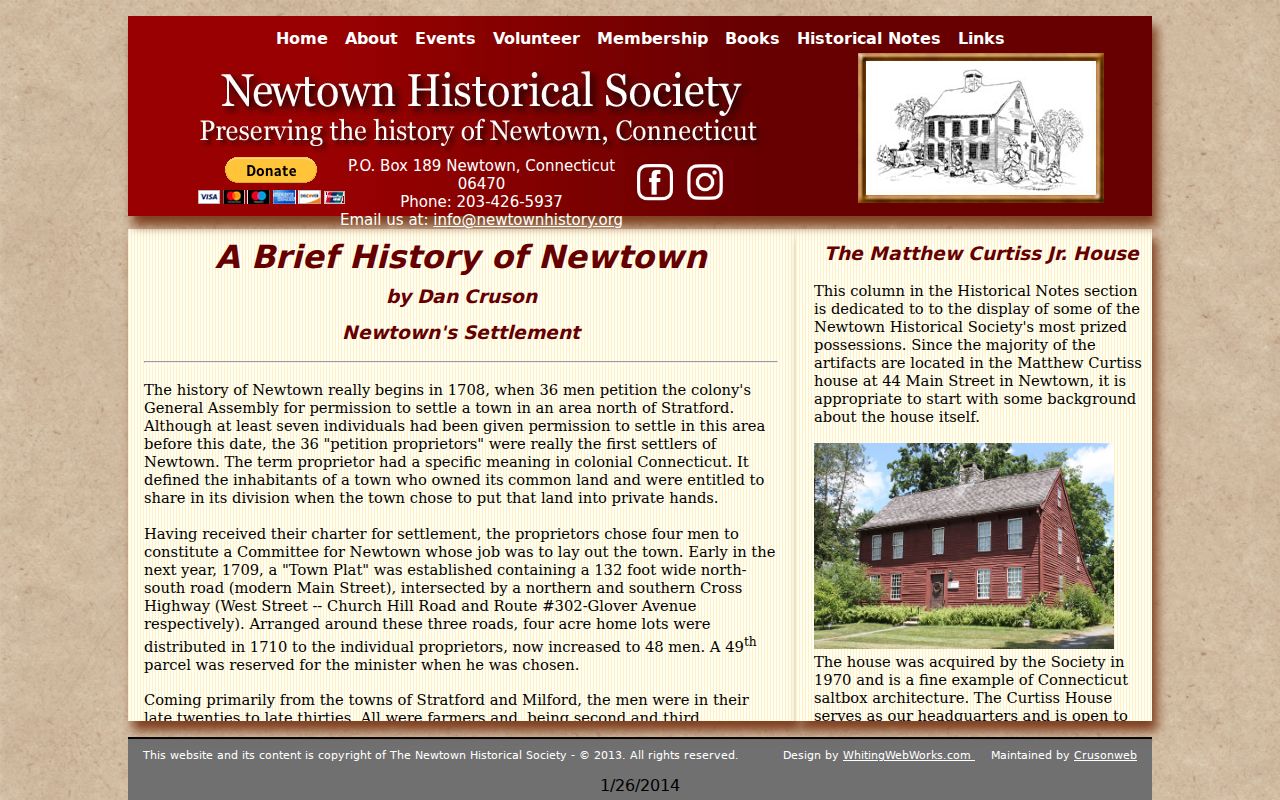
The settlement image is useful as a history cue. The deed book, map, and legal description still supply the evidence needed to connect that early place to a later address.
Newtown Directories for Previous Residents
Printed directories add the people layer that deeds lack. Bridgeport Public Library holdings include 1963, 1965, 1967, 1969, 1971-72, 1974, 1976, 1978, and 1981. The Library of Congress offers a 1956-1959 Danbury-area telephone sample with Newtown entries. Use the Bridgeport holdings list and the LOC regional directory page to identify the closest edition.
Write down the road exactly as printed. A directory entry can show an occupant, telephone line, locality, spouse or household note, and sometimes a period field such as an occupation. It is a dated publication snapshot, not title evidence. Put its address beside the deed's legal description and use the match, not either source alone, to move backward.
The historical directory collection itself is described on the Newtown Directory Book page, while this trail uses those editions to connect one parcel with people who appeared there at different times.
Newtown Bee and 1890 Residents
The Library of Congress Newtown Bee catalog runs from 1877-current. Selected Connecticut film runs include 1877-1882, 1887-1900, and 1979-current. The paper can connect a directory entry to a move, death notice, marriage, civic name, or road label, but it cannot prove title. Pair the notice with the deed and keep its date in the address timeline.
Newtown's local 1890 substitute is the human-use bridge after the federal schedule loss. School records, Grand List material, voter files, and new-elector records can rebuild a household clue for that year. C.H. Booth's local binders also include Newtown Bee vital records from 1889-1953. Treat each index as a lead and inspect the underlying notice or file when the relationship matters.
Earlier occupants may appear under a village name such as Sandy Hook, Botsford, or Hawleyville. Keep that place wording with the town name when searching the newspaper and directory page.
Newtown House History for Residents
The C.H. Booth Library genealogy resources are the practical house-history route when an online index ends. The third-floor Genealogy Room grew from Julia Brush's collection and holds more than 900 volumes, local binders, correspondence, unpublished work, church and cemetery material, and family files. Reference staff can help identify a collection without treating the files as a public name-search system.
The library is at 25 Main Street, 203-426-4533, with published hours Monday through Thursday 9:30 a.m. to 8:00 p.m., Friday and Saturday 9:30 a.m. to 5:00 p.m., and closed Sunday. The Newtown Historical Society adds photographs, postcards, genealogies, artifacts, and oral-history context. Its Matthew Curtiss House at 44 Main and Little Red Schoolhouse at 7 Cold Spring are place anchors for a house-history question.
The society's “Newtown Remembered” oral history by town historian Dan Cruson records twentieth-century houses and residents. It can supply a name, former house reference, or neighborhood lead, then the formal deed, directory, newspaper, or probate record can test it.
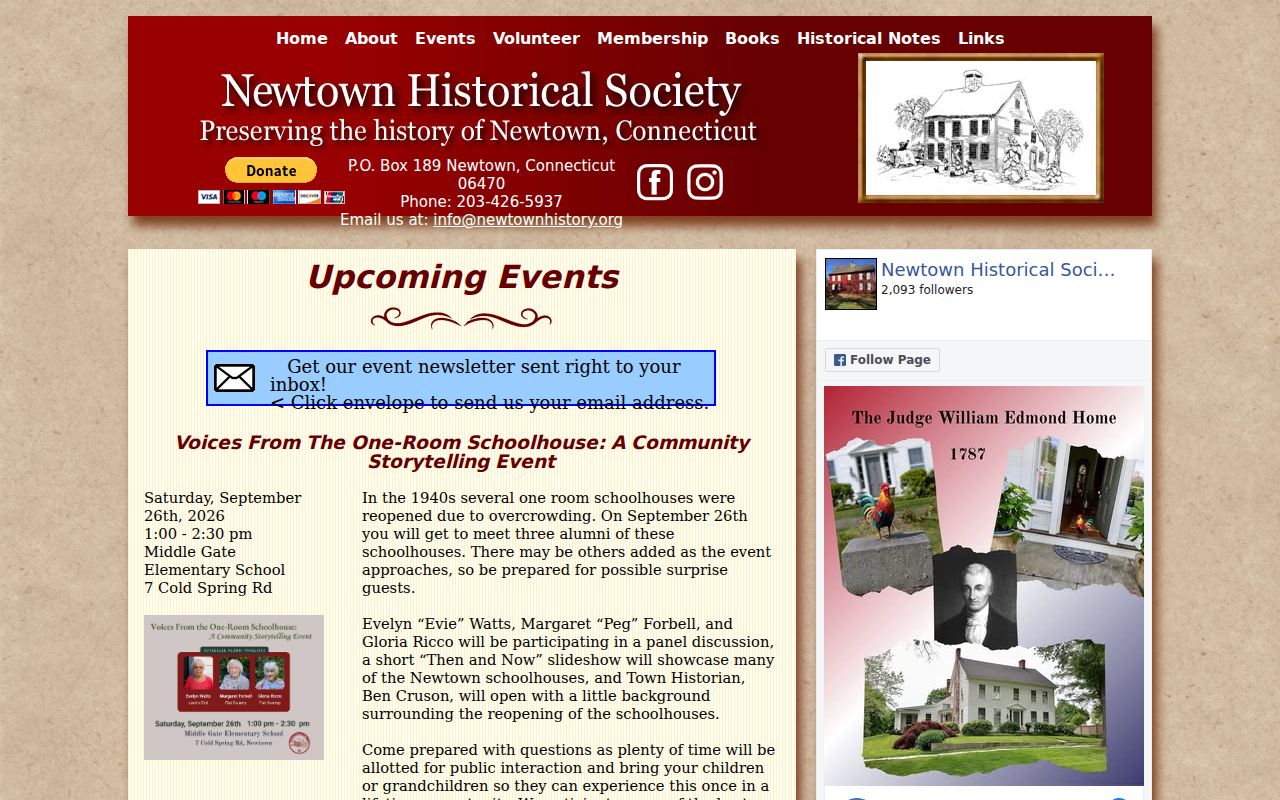
The Historical Society image points to local memory as a companion to the land record, not as a substitute for a recorded instrument.
Newtown Probate and Past Residents
Probate and obituary records can close a past-resident trail. Newtown matters moved to Northern Fairfield Probate in Bethel on January 5, 2011, after the former Newtown district ended. An estate file may connect a deceased owner to heirs, a spouse, or a transfer that explains the next deed. A newspaper obituary or Booth index can supply the date and relationship that points to the right probate name.
Building Department and Land Use files may add construction, alteration, inspection, or applicant clues, but no online permit start year or public address-keyed case index was located. Use a focused counter or FOI request with the parcel, date range, and record type. Do not turn the absence of an online index into a claim that no permit exists.
The Library of Congress Sanborn resources guide explains the map fields that can show structures, street lines, lot use, and fire or water details. No Newtown-specific Sanborn volume or year was located in the official search.
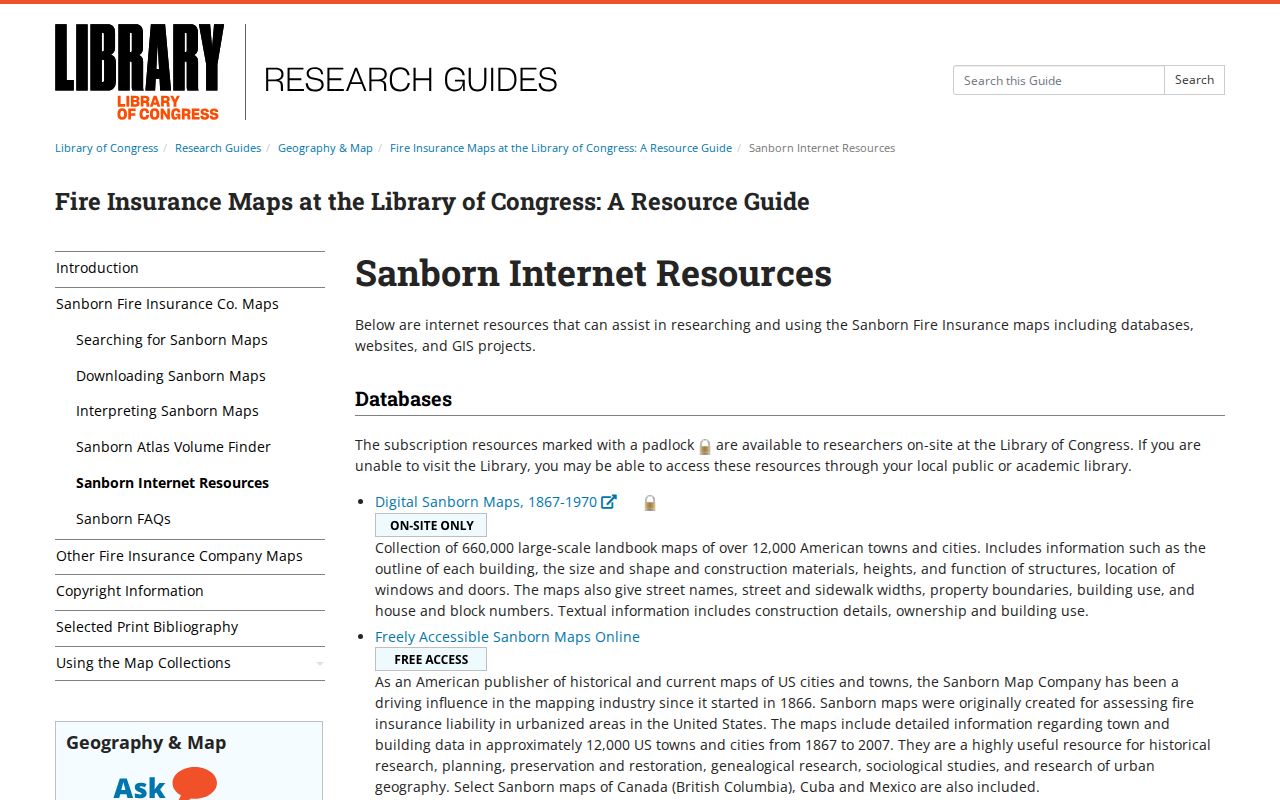
The Sanborn image documents the method and its limit. Verify a Newtown sheet before assigning a map year to an address.
The FamilySearch Connecticut wills and deeds collection offers another index and image route, with availability varying by book, account, and location.
Use the FamilySearch result as a lead to a book or image, then compare it with the Town Clerk's local record when the deed chain matters.
Newtown Past Residents by Year
Earlier residents appear in two different layers: a deed records a transfer of land, while a directory, census, or newspaper places people near an address at a point in time. Pair the layers in order, and keep the source type beside every name.
- Save the current parcel, MBL, legal description, owner, mailing address, and exact road label.
- Walk the deed chain backward from grantee to grantor, stopping at each book, page, and prior reference.
- Choose the nearest BPL or LOC directory year and compare its address with the deed's land description.
- Use the Newtown Bee, 1890 substitute, and released census year to test household links between transfers.
- Finish with probate, obituary, cemetery, or local-history evidence, and record every access gap honestly.
That process can identify Newtown past residents without pretending that one source is a complete roster. A name in a directory is not automatically an owner, and an owner on an assessor card is not automatically a current occupant. A careful trail says what each record shows and where the next check must happen.
Lawful house-history use. Keep address-history research to family history, house history, archival study, and personal curiosity. Do not use an address trail to stalk, harass, or track a living person, and do not treat protected records as clues to work around.