
Newtown's City Directory Shelf
Newtown's historical directory shelf is spread across institutions rather than one complete town run. The clearest local list is the Bridgeport Public Library History Center's Newtown print and telephone holdings. It names selected years, but its public page does not consistently identify a publisher or promise a scan for every volume. The Library of Congress adds a regional telephone sample, while C.H. Booth Library holds local binders, family files, and reference sources that help explain the names found in print.
| Collection | Years | Where Held | Access |
|---|---|---|---|
| Newtown print and telephone holdings | 1963, 1965, 1967, 1969, 1971-72, 1974, 1976, 1978, 1981 | Bridgeport Public Library History Center | Public holdings list; request a scan or reference lookup and verify the title page |
| Regional telephone directory sample | 1956-1959 | Library of Congress digitized collection | Danbury-area page images include Newtown entries |
| Newtown Bee | 1877-current in the catalog; selected film runs | LOC, Connecticut State Library, and C.H. Booth | Catalog, microfilm, and local research routes for notices and obituaries |
| Local genealogy binders and town records | 1711-1852, 1715-1946, and 1889-1953 runs | C.H. Booth Genealogy Room | Reference-desk access; these files are not a public name-search API |
| Newtown 1890 substitute | 1890 | C.H. Booth and Genealogy Club files | School, Grand List, voter, and new-elector material rebuilds a local household trail |
The table separates a true directory run from companion evidence. A newspaper can explain a move, and a local binder can supply a family link, but neither replaces the page image or title record for a particular volume. A Newtown reverse or criss-cross run was not confirmed in the public catalog, so an address search should be requested from the History Center or Booth reference desk rather than assumed to exist.
The Bridgeport Public Library directory holdings page is the source for the selected Newtown years above and is the best first stop for an edition-level request.
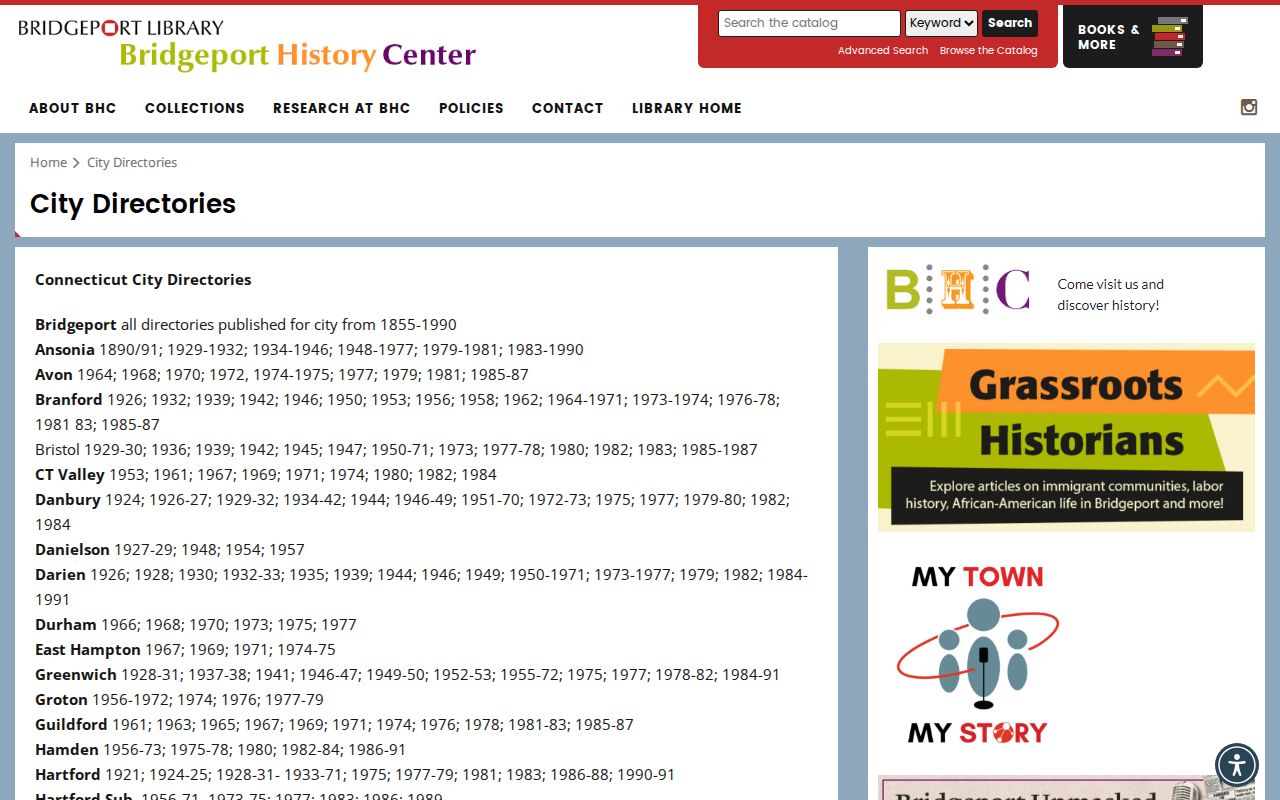
The holdings list gives a firm starting point, while a scan or title page is still needed to identify a volume's exact publisher and pagination.
Newtown City Directory Years
The Bridgeport list is deliberately selective: 1963, 1965, 1967, 1969, 1971-72, 1974, 1976, 1978, and 1981. Those gaps do not end a family search. They tell the researcher to use the closest printed year, then add a newspaper notice, census year, deed, or local file to narrow the change between editions. The list also avoids a common mistake, naming a familiar publisher without checking the volume's own title page.
For a useful citation, record the institution, exact title, edition year, page number, town or regional coverage, and the abbreviation key used by that book. If a requested year is not on the public list, ask whether it is in a neighboring shelf, a telephone run, a microfilm reel, or a reference file. No complete Newtown-only annual run was identified in the sources reviewed, so the access question should remain specific and modest.
Note: A missing Newtown directory year is a prompt to pair nearby editions with local newspapers and census records, not proof that no household record survives.
Reading Newtown Directory Pages
The inspected 1956-1959 Library of Congress regional sample is a Danbury-area telephone directory, not a Newtown-only city directory. Its Newtown entries show surnames with given names or initials, road or locality wording, telephone numbers, repeated surname lines, and a tight vertical column layout. Poverty Hill, Botsford Road and Sandy Hook, Hawleyville Road, and South Main appear as place clues. The page shows why an old address can be more useful than a broad town-name search.
| Name | Surname, given name or initial, with repeated surname entries kept in their printed order. |
|---|---|
| Address | House number, road, and locality such as Sandy Hook, Botsford, Hawleyville, or South Main. |
| Telephone | A historic number or exchange when printed; use it as a dated clue, not a current contact record. |
| Occupation | Some full directories print an occupation; the inspected regional telephone page does not make that field universal. |
| Spouse or household | Parentheses, widow notes, or household references may appear, but each edition's conventions must be checked. |
| Tenure mark | Some volumes use a tenure symbol. Treat the mark as unknown until the volume's abbreviation key explains it. |
Read the page from the back matter as well as the name line. A road abbreviation can look like a different street, and a regional telephone directory may place Newtown entries under a village or exchange label. Do not copy a living person's phone number from a historical scan into a public list. The value of the page is its date, spelling, place, and relationship to other records.
- Criss-cross directory
- An address-first section that turns a street or house into an occupant lead instead of starting with a surname.
- Householder index
- A name-first index that points to the address or page where the household is listed.
- Abbreviation key
- The volume's guide to shortened roads, localities, occupations, and household marks. Photograph or transcribe it before searching.
- Regional telephone directory
- A book covering a wider calling area, so a Newtown entry may sit beside nearby place names.
Newtown City Directory Fields
Before following a name, make a small entry inventory. Write the spelling exactly, including an initial, suffix, married name, or shortened road label. Then capture the edition, page, address, telephone exchange, and any household note. This keeps the entry in its historical setting and makes it possible to compare the same person with a deed, a newspaper notice, or the 1890 substitute.
- Printed name, initials, and repeated surname lines.
- House number, road name, village or locality, and any address abbreviation.
- Telephone number or exchange, where the volume supplies one.
- Spouse, widow, household, or boarder notation, if the edition uses it.
- Occupation or business wording, when a full directory includes it, cited only as a period field.
A directory records an indexed name at a publication date. It does not by itself prove ownership, a complete household, or continued residence after the book went to press. Compare the name with a second source before treating an address change as a move or a disappearance as a death. An internal spelling difference can be the key to finding the next edition.
The Booth Genealogy Room
The C.H. Booth Library genealogy page describes a third-floor Genealogy Room built around Julia Brush's collection. It holds more than 900 volumes on Newtown, family history, and nearby Connecticut towns, along with correspondence, unpublished genealogical work, primary sources, local binders, and reference files. This is the place to ask about a directory gap, a family file, or a local name that appears in more than one printed source.
The Booth collection gives Newtown directory research a human research desk: staff can point to a binder or manuscript index when a web search returns only a name.
The library is at 25 Main Street and lists 203-426-4533 for reference help. Published hours are Monday through Thursday, 9:30 a.m. to 8:00 p.m., Friday and Saturday, 9:30 a.m. to 5:00 p.m., and closed Sunday. In-library access includes Ancestry Library Edition and American Ancestors, while the local shelves include Newtown Bee vital-record binders, church records, cemetery material, and family files.
Newtown's Digitized Directory Routes
The Booth research resources page points readers toward the Newtown Bee, NewsBank, researchIT CT, and wider genealogy tools. The Connecticut State Library History and Genealogy guide and Connecticut's Archives Online at WCSU provide routes for indexes and manuscripts that are not on the open shelf. Search by collection, place, and date, then ask a reference desk whether a scan, reel, or finding aid is available.
The image source shows the broader research doorway rather than a single directory page. That distinction matters because digitized access may expose a catalog record while the page image remains limited to a library, archive, or account.
FamilySearch's Connecticut wills and deeds collection adds a deed and probate route with coverage that varies by book, county, account, and image availability. Its catalog search can be narrowed by place, title, author, subject, surname, call number, or DGS number. Use it as a second line beside Newtown's Town Clerk books, not as a promise that every local volume is indexed.
Newtown Bee Alongside Directories
The Library of Congress catalog for the Newtown Bee begins with volume 1, number 15, dated October 4, 1877, and describes a weekly paper published by A.A. Bensel that continues in the catalog to the present. Connecticut State Library film runs include 1877-1882, 1887-1900, and 1979-current, with four titles listed in the Newtown distribution record. C.H. Booth also carries local newspaper and obituary research routes.
Pair a directory year with the nearest Newtown Bee run. A notice can explain a move, a death, a marriage, a civic role, or a change in a road label that a directory only records as a new line. The newspaper is not a deed and an obituary is not proof that a person occupied the address on every date. It is a dated bridge between printed household snapshots.
The Newtown Bee vital-record binders cover 1889-1953 in the Booth Genealogy Room, while the library's obituary index is listed for 2004-2009. Ask for the underlying notice when a name matters. A short index entry can point to the page that supplies a relationship, address clue, or alternate spelling.
Tracing Families in Newtown Directories
A printed directory becomes useful for family history when each edition is treated as one dated observation. Start with a known surname and place, then preserve the printed form before normalizing it. The next year may show a new road, a spouse or widow note, a different initial, or no entry at all. Each change needs a second record before it becomes a conclusion.
- Choose the closest Newtown directory year and copy the name, address, page, and abbreviation key.
- Check the next available edition, then the prior one, keeping every road and locality variant.
- Use the criss-cross section to move from an address to other listed occupants and nearby names.
- Pair the printed years with the 1890 local substitute and federal census years released under the 72-year rule.
- Close the gap with a Newtown Bee notice, cemetery file, probate record, or another independent source.
If a person vanishes from one edition, possible explanations include a move, a death, a change in listing practice, or an unindexed household. Check the newspaper and family files before choosing one. For a present-day identity question, a historical directory should remain the starting clue, not the final confirmation.
Newtown's 1890 Substitute
The federal 1890 population schedule was destroyed, but Newtown has a local substitute that restores part of the missing household layer. C.H. Booth and the Genealogy Club identify school records, Grand List material, voter files, and new-elector records for 1890. These sources can connect a name to an age, household, place, or civic record when a printed directory does not reach the year in question.
Use the substitute in its original context. It is a reconstruction from several local files, not a replacement for the lost federal form and not a complete modern resident list. Compare the spelling, age, road, and family link with a Newtown Bee notice, a cemetery record, a deed, or a later printed volume. That human-use route is especially valuable when a family appears before the selected Bridgeport years.
Note: Newtown's 1890 substitute is a local research bridge built from surviving records, so each name should be checked against the file that supplied it.
Newtown House History Anchors
The Newtown Historical Society's house-repair and tour page gives a place-based route beyond a directory entry. The Matthew Curtiss House at 44 Main and the Little Red Schoolhouse at 7 Cold Spring connect printed names with surviving places and local preservation work.
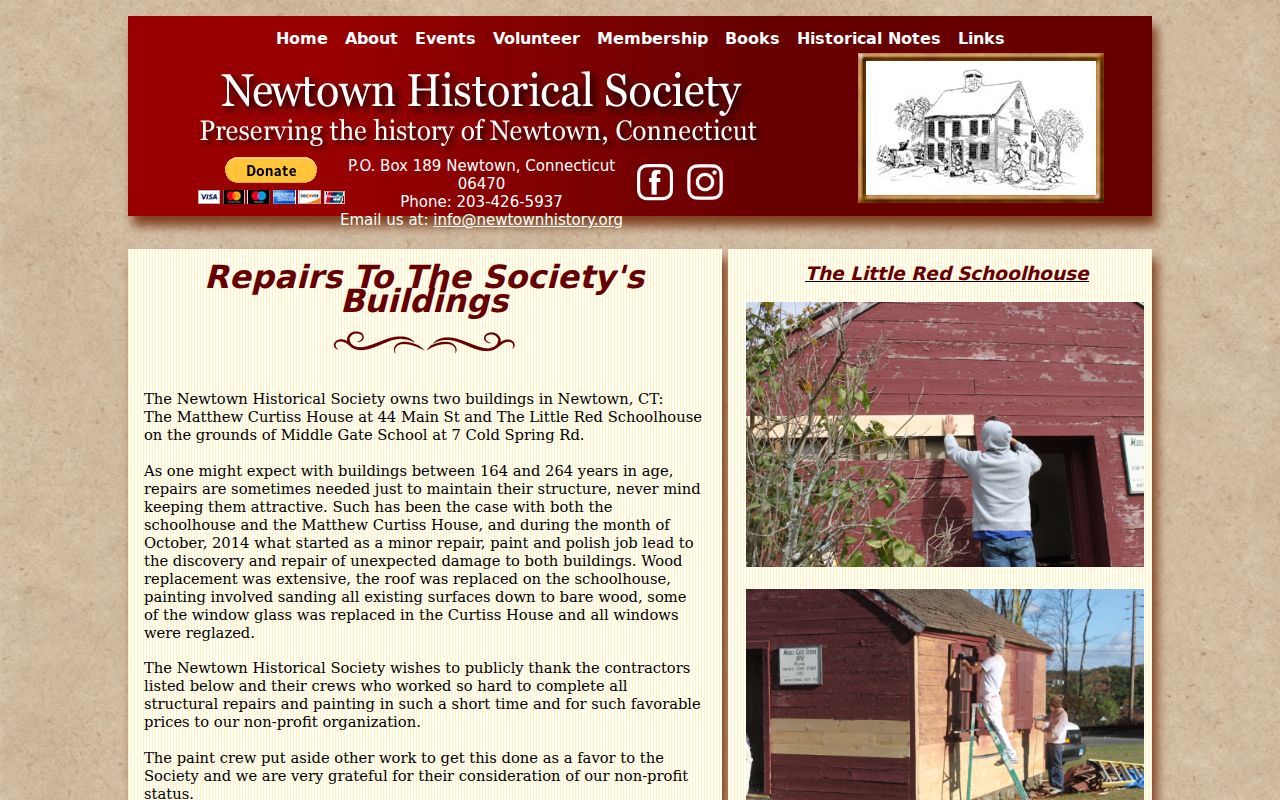
The Historical Society's photographs, postcards, genealogies, stories, and artifacts can supply context for a road or family file. Tours are listed one Sunday each month from March through June and September through December, with no admission listed on the source page.
“Newtown Remembered,” an oral history by town historian Dan Cruson, adds twentieth-century memories of houses and residents. Oral history is context rather than an indexed directory, but it can identify a former house name, family connection, or place clue worth checking in the formal record.
Newtown's Early Road Names
The Historical Society settlement history records a 1708 petition, a 1709 town plat, and 48 proprietors by 1710, followed by Newtown's establishment in 1711. Four-acre home lots and early roads created the legal-description framework that later deeds, maps, and directory addresses had to inherit. The history connects early routes with modern Main, West or Church Hill, and Route 302.
That map history explains why an old Newtown address may not match a current street string. Keep the printed road name, village label, lot reference, and legal description together. A directory can suggest who stood at a place, while a deed book, map, or local history source explains how that place was named. The strongest household trail follows both the person and the land.